پژوهشنامه رسانه بین الملل

پژوهشنامه رسانه بین الملل

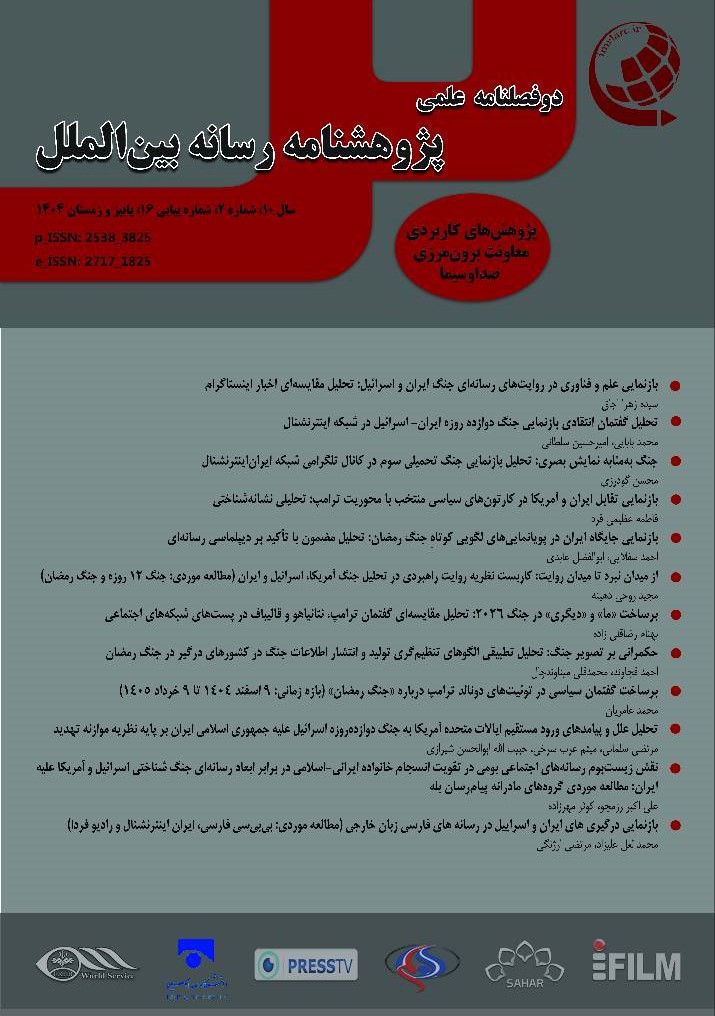
بازنمایی جایگاه ایران در پویانمایی‌های لگویی کوتاهِ جنگ رمضان: تحلیل مضمون‌ با تأکید بر دیپلماسی رسانه‌ای

نوع مقاله : مقاله پژوهشی

نویسندگان
1 استادیار گروه هنر های دیجیتال، دانشکده تولید رادیو و تلویزیون، دانشگاه صداوسیما، تهران، ایران.
2 استادیار پژوهشکده هنر، پژوهشگاه فرهنگ، هنر و ارتباطات، تهران، ایران. (نویسنده مسئول).
10.22034/imrl.2026.589021.1379
چکیده
گسترش شبکه‌های اجتماعی با مخاطبان بین المللی و رواج قالب‌های کوتاه ویدئویی، شیوه‌های بازنمایی رویدادهای سیاسی و نظامی را دگرگون کرده و پویانمایی‌های لگویی کوتاه را به یکی از قالب‌های نوظهور روایت‌پردازی رسانه‌ای تبدیل کرده است. پژوهش حاضر با هدف تحلیل چگونگی بازنمایی جایگاه ایران در جنگ رمضان در پویانمایی‌های لگویی کوتاه و تبیین ظرفیت‌های این آثار در دیپلماسی رسانه‌ای انجام شد. این پژوهش با رویکرد کیفی و به روش تحلیل مضمون بر اساس الگوی شش‌مرحله‌ای براون و کلارک انجام گرفت. جامعه پژوهش شامل پویانمایی‌های لگویی منتشرشده در شبکه‌های اجتماعی با موضوع جنگ رمضان بود که شش نمونه به‌صورت هدفمند انتخاب و تحلیل شدند. یافته‌ها نشان داد که الگوی بازنمایی این آثار در قالب پنج مضمون اصلی شامل «فشرده‌سازی و ساده‌سازی روایت جنگ»، «قهرمان‌سازی و مشروعیت‌بخشی به کنش ایران»، «بازنمایی تهدید و ساخت دیگری»، «بسیج عاطفی مخاطب» و «سازگاری با منطق پلتفرم‌ها و اقتصاد توجه» سازمان یافته است. این مضامین نشان می‌دهند که پویانمایی‌های لگویی با ساده‌سازی منازعات پیچیده، برجسته‌سازی نقش ایران و بهره‌گیری از ظرفیت‌های روایی و الگوریتمی شبکه‌های اجتماعی، در شکل‌دهی به ادراک مخاطبان و تولید روایت‌های سیاسی نقش فعالی ایفا می‌کنند. در نتیجه، این آثار را می‌توان فراتر از قالبی سرگرم‌کننده، ابزاری نوین برای بازنمایی سیاسی، دیپلماسی رسانه‌ای و تقویت قدرت نرم در فضای رسانه‌های اجتماعی دانست.
کلیدواژه‌ها

عنوان مقاله English

The Representation of Iran's Status in the Short Lego Razm (Lego-Based Animations) of the Ramadan War: A Thematic Analysis with an Emphasis on Media Diplomacy.

نویسندگان English

Ahmad Soflayi 1
Abolfazl Abedi 2
1 Iribu
2 Assistant Professor, Art Research Institute, Institute for Cultural, Artistic and Communication Research,Tehran, Iran.
چکیده English

The expansion of social media platforms with international audiences and the growing popularity of short-form video content have transformed the ways political and military events are represented, making short LEGO animations an emerging format of media storytelling. This study aims to examine how Iran’s role in the Ramadan War is represented in short LEGO animations and to explore the potential of these productions as instruments of media diplomacy. Adopting a qualitative approach, the research employed thematic analysis based on Braun and Clarke’s six-phase framework. The research corpus consisted of LEGO animations related to the Ramadan War published on social media platforms, from which six samples were purposively selected and analyzed. The findings revealed that the representational pattern of these animations is organized around five major themes: (1) compression and simplification of war narratives, (2) heroization and legitimization of Iran’s actions, (3) representation of threat and construction of the “Other,” (4) emotional mobilization of audiences, and (5) adaptation to platform logic and the attention economy. These themes indicate that, by simplifying complex conflicts, emphasizing Iran’s role, and exploiting both the narrative and algorithmic affordances of social media platforms, short LEGO animations actively contribute to shaping audience perceptions and constructing political narratives. The study concludes that these productions should be understood not merely as entertainment but as emerging tools of political representation, media diplomacy, and the enhancement of soft power within the social media environment.

کلیدواژه‌ها English

LEGO animation
Representation
Media diplomacy
Thematic analysis
Ramadan War
فهرست منابع
Benford, R.D. and Snow, D.A. (2000). Framing Processes and Social Movements: An Overview and Assessment. Annual Review of Sociology, 26, 611-639.
http://dx.doi.org/10.1146/annurev.soc.26.1.611
Bjola, C., & Holmes, M. (2015). Digital Diplomacy: Theory and Practice. London: Routledge.
Braun, V., & Clarke, V. (2006). Using thematic analysis in psychology. Qualitative Research in Psychology, 3(2), 77–101.                        https://doi.org/10.1191/1478088706qp063oa
Braun, V., & Clarke, V. (2022). Thematic Analysis: A Practical Guide. Sage.
Borousard, M. (2023). More Than a Glitch: Confronting Race, Gender, and Ability Bias in Tech. MIT Press.
Bucher, T. (2018). If... Then: Algorithmic Power and Politics. Oxford University Press.
Castells, M. (2010). The Rise of the Network Society (2nd ed.). Wiley-Blackwell.
Coleman, R. (2010). Framing the pictures in our heads: Exploring the framing and agenda-setting effects of visual images. In P. D'Angelo & J. A. Kuypers (Eds.), Doing News Framing Analysis: Empirical and Theoretical Perspectives (pp. 233–261). Routledge.
Davenport, T. H., & Beck, J. C. (2001). The Attention Economy: Understanding the New Currency of Business. Harvard Business School Press.
Entman, R. M. (1993). Framing: Toward clarification of a fractured paradigm. Journal of Communication, 43(4), 51–58.
https://doi.org/10.1111/j.1460-2466.1993.tb01304.
Entman, R. M. (2004). Projections of Power: Framing News, Public Opinion, and U.S. Foreign Policy. University of Chicago Press.
Fisher, W. R. (1987). Human Communication as Narration: Toward a Philosophy of Reason, Value, and Action. University of South Carolina Press.
Gilboa, E. (2001). Diplomacy in the media age: Three models of uses and effects. Diplomacy & Statecraft, 12(2), 1–28.
https://doi.org/10.1080/09592290108406201
Gillespie, T. (2018). Custodians of the Internet: Platforms, Content Moderation, and the Hidden Decisions That Shape Social Media. Yale University Press.
Hall, S. (1997). Representation: Cultural Representations and Signifying Practices. Sage.
Hoskins, A., & O'Loughlin, B. (2010). War and Media: The Emergence of Diffused War. Polity Press.
Jenkins, H. (2006). Convergence Culture: Where Old and New Media Collide. New York University Press.
Jenkins, H., Ford, S., & Green, J. (2013). Spreadable Media: Creating Value and Meaning in a Networked Culture. New York University Press.
Kellner, D. (2003). Media Spectacle. Routledge.
Kress, G., & van Leeuwen, T. (2006). Reading Images: The Grammar of Visual Design (2nd ed.). Routledge.
Manor, I. (2019). The Digitalization of Public Diplomacy. Palgrave Macmillan.
Manovich, L. (2001). The Language of New Media. MIT Press.
McQuail, D. (2010). McQuail's Mass Communication Theory (6th ed.). Sage.
Miskimmon, A., O'Loughlin, B., & Roselle, L. (2013). Strategic Narratives: Communication Power and the New World Order. Routledge.
Russell, S., & Norvig, P. (2021). Artificial Intelligence: A Modern Approach (4th ed.). Pearson.
Simon, H. A. (1971). Designing organizations for an information-rich world. In M. Greenberger (Ed.), Computers, Communications, and the Public Interest (pp. 37–72). Johns Hopkins University Press.
Virilio, P. (1989). War and Cinema: The Logistics of Perception. Verso.
 
دوره 10، شماره 2 - شماره پیاپی 16
سال دهم، شماره دوم، شماره پیاپی شانزدهم، پاییز و زمستان 1404
مهر 1404
صفحه 147-173